Showing posts with label review. Show all posts

Sunday, July 13, 2014

"Maxi's Place: Volume One" by [Literary Stud]


I won this book via Goodreads Giveaway. Although I would like to tell you that the author doesn't genuinely go by "Literary Stud", I would unfortunately be lying.

The book is 124 pages long--which hardly even counts as a novella, if you ask me--and is split into three "Episodes"--his words, not mine: Rumors Ring True, It's Complicated, and The Lies We Tell. As far as I can tell, there was seriously no point in splitting the book into three 'sections' when the plot can very obviously speak for itself and the book certainly isn't long enough to demand headings.

Furthermore, I would like to heartily shame his "team of editors" on his "acknowledgments" page--and I realize that technically that word is correct without the 'e' preceding 'ments', but it's not aesthetically pleasing and, generally speaking at any rate, less accepted. Although I'm not sure I want to know what this looked like before they got their hands on it, I certainly can't praise them for letting it leave their hands in the state that it's in.

I couldn’t even finish reading the book because of how absolutely dreadful it was. I made it halfway through “Episode 2″ before I finally just gave up and abandoned ship–something I have never done before. To be blunt, I wish that there was a negative stars rating option so that I could fully encompass to you all just how bad this book really is. As it stands, I am forced by the Goodreads system to give it 1 star, even though I swear to you it doesn’t deserve it.

From the start of the “novel”, the sentences are absurdly short and stilted; the paragraphs have no flow to speak of, and the dialogue is at least as stilted–if not more so. The prose is so genuinely staccato that it’s straight up hard to read. When sentences don’t flow together, it leaves you reading like a second grader who hasn’t quite graduated from picture books yet. The other significant issue with the dialogue–besides its lack of realistic vernacular, etc, is that nobody is provided with an accent. It might be hard to describe in-text an accent that you live around because it can be hard to hear, but even Texans know how southerners talk and should be able to produce a drawl on paper. Dialects include more than just phonological (sounds) variation, but also word choice and phrase structure, and I’m not seeing any of that presented here. This robs the characters of a huge part of their identity, and really short changes what the story potentially could be. (This review might have been less scathing if the characters actually had any, you know, character to them.)

There are also some inaccuracies that a person might not catch if they weren’t well-versed in musical instruments. Like, for example, you don’t “flex the tone holes” of a tenor saxophone. I don’t even know what that’s supposed to mean, and I played the saxophone in high school. (It wasn’t my main instrument, but I did play it.) Frankly, I don’t think you even have to be versed in musical instruments to take exception to that statement.

In the same scene as the saxophone issue, the character in question is listed as wearing an "A-shirt" with a "labrys" against her stomach. Does anybody else know what an A-shirt is? I had to google that shit, and you know what I found? It's a wife beater, you guys. It's a wife beater. Which I realize is really politically incorrect and gives the wrong 'vibe' for an outfit or whatever, but at least we know what it is. A "white ribbed tank top" would be equally as descriptive and still a better option than an "A-shirt". How about a labrys? I googled that shit, too, and it's a symmetric doubleheaded axe originally from Crete in Greece. So whatever the hell “Stud” meant–which was probably something related to the neck strap of the saxophone, if I had to guess–I really don’t think this was it, unless his saxophone player was wearing a fucking axe around her neck.

But let’s talk plot for a bit, shall we? At least until I get derailed again. Ava is our main character, and apparently a lesbian. Which is fine; I don’t care. And she’s apparently crushing on the aforementioned saxophone player Bailey, who apparently has a reputation for being a heart breaker. Or something. And Bailey develops the hots for Ava as well–because what else?–and despite the protestations and meddling of her coworker(s) and boss, they get together and start dating.

For the record, Chapter 2 starts with the sentence “Fish problems were not Daniel’s forte.” As in issues between lesbians. I shit you not. If the goal was to make me dislike Daniel as swiftly as possible, I would finish this out with a “job well done!”, but I honestly can’t find a single reason to like any of the characters mentioned thus far. Ava lacks any description whatsoever and is highly inconsistent in terms of behavioral patterns. Bailey keeps referring to herself as a nigga and throws around “muthafucka” like it’s rice at a wedding. Even if Bailey is supposed to be “ethnic” or, how shall I say, "really black", Stud is not doing a good job at depicting whatever it is she means her to be. Daniel is a snide prick who likes to cause drama and Cole (short for Colette), the boss–who is apparently also a chick–is a noncommittal, promiscuous lesbian who keeps calling Bailey “son”.  I really, seriously can’t figure out what “Stud” is trying to accomplish with any of these characters.

Oh, in terms of calling Bailey “son.” It’s possible–even somewhat likely–that Bailey has chosen to identify with masculine pronouns. And that’s fine. Great, even. This is probably the only positive thing I will say for ‘Literary Stud’ is that she makes my inner feminist happy in not limiting her characters to societally-dictated pronouns dependent upon genitalia. However. That’s as far as the praise goes, because it really deserves some kind of explanation of Bailey’s character before you start dropping opposing-gender pronouns on a character. Calling Bailey “son” entirely out of the blue without any kind of commentary on who Bailey is–and previously calling her “her” and “she”–it just seems out of place and disjointed. Or an error.

Even knowing that “Stud” is a lesbian who also chooses masculine pronouns–which I’m probably rudely violating in using feminine pronouns in this post, but they’re staying because I’m not invested enough to go back through and find them all and change them.

By the end of Chapter 3, Ava and Bailey have reconciled their misunderstanding (which is actually just the hesitation brought about by hearing rumors regarding a reputation which has apparently been largely earned) and make out in a porn shop. The reaction of the sales associate is entirely unrealistic–”Hey you two! I love the show but you’re going to have to take it somewhere else” says an unnamed voice, which is completely stupid because seriously, if you work in a sex shop, you’ve seen enough shit that watching lesbians awkwardly paw each other by a wall of strap ons isn’t a turn on anymore (although why it ever would have been is beyond me). I have friends who have worked in porn shops and they’ve all said the same thing of themselves and their coworkers. It’s just not… feasible? likely? accurate? plausible? I don’t even know what word you want me to use. The subsequent conversation isn’t exactly realistic either, ending with: “Why don’t we pay for these items and go get a quick bite to eat?” Who even says that? Nobody calls the stuff they’re buying “items” and nobody goes for a “quick bite to eat” right after they’ve made out and bought a strap on. I mean, unless they’re referring to eating some vagina, but they literally walk across the street to a twenty-four hour restaurant specializing in breakfast food.
Dude. What? Across from the porn shop? NO. Just no. Other cultures don’t handle sex the same way that America does, but even in Texas the porn shops are tucked away out of sight of potential “family-centered” establishments.

Also, just for the record, here are a few helpful little grammar lessons brought to you courtesy of Literary Stud.

Helpful little grammar lesson #1: You do not need a comma between an adjective and its modifying adverb. "A black plastic bag" is allowed precisely 0 commas because "black" is modifying "plastic", which is modifying "bag"; therefore you do not place a comma between them. Glad we could have this talk.

Helpful little grammar lesson #2: when you're dealing with dialogue, a quote plus its tag is one whole sentence. Let me illustrate:
"Let's walk to the car," she said.
Notice how the end of the quotation has a comma? That's because 'she said' is part of your sentence and belongs inside the period with whatever it is that's inside quotation marks. The only time you get to have
"Let's walk to the car."
is if the proceeding phrase is an independent clause or sentence, such as 'She turned around and strutted away without looking to see if I was following." or "She grinned and waggled her eyebrows."

ALSO. You don't use any punctuation at all at the end of your quotation in cases such as
"Let's walk to the car" was the last thing I heard before a sharp pain caused my vision to go black and I lost consciousness.
*None of these sentences are examples from the book.

Helpful little grammar lesson #3: ALWAYS ALWAYS ALWAYS END CHAPTERS WITH PUNCTUATION UNLESS:

1. You are quoting a poem or song distinctly lacking punctuation

  • Don't ever give somebody else the last word in your work, whether its creative or academic. You're basically removing authority from yourself by handing it over to somebody else and you don't want to do that--especially not in your creative writing.


2. |

Actually that's it. That's the only reason you should ever neglect to punctuate the end of your chapter, which I just explained you shouldn't ever do, which leaves you with the aforementioned rule listed in all caps, sans "unless." Always end sentences, paragraphs, and chapters with punctuation.

Helpful little grammar lesson #4: It's always, always better to underuse commas than to overuse them.


Someone apparently should have shared these with “Literary Stud” before letting her destroy some beautiful trees with her bad grammar and even worse content.

On a separate note, I don’t think I came across a single female character in this story who wasn’t gay. Even when there was discussion of Cole’s family. I mean, obviously Cole’s mom had to have had sex with a dude (or been inseminated, whatever), but nothing is said of the mom, only of Aunt Maxi, who was also a lesbian and equally as noncommittal as Cole apparently is. And apparently “the only father Cole had ever known.” And every employee at this club/restaurant/bar is female with the exception of Daniel. And, as far as I can tell, they’re all gay. Every single one of them. I mean, whatever, but so far the only non-gay character who’s been named is Daniel–and it isn’t even for sure that Daniel is straight, just that he doesn’t deal with lesbian–excuse me, “fish”–problems. That is not a statement of heterosexuality.

This doesn’t work. It just doesn’t.

There’s a statement in part two that reads “Now if only her sexy ass wasn’t such a womanizer, she would be a half decent Stud.” And I don’t know what the fuck this is supposed to mean. It comes with no explanation, no further comment, nothing. That’s it. And “Stud” is capitalized. Again: why? I don’t know, and I’m not going to waste energy thinking about it. The proceeding page reveals a less-professional relationship having existed between Cole and her head chef, Tasha, during which she calls Tasha’s girlfriend her “stubby.” I am fairly well-versed in lesbian terminology and I have never heard any of these terms–at least not used in these contexts.

Sometimes, you’re really better off using words that your readership is going to recognize and be comfortable with. Even when the big word sounds more impressive, or makes you look more “authoritative” on a subject, if your readership isn’t going to know what it means, you’re just going to look either pompous/pretentious or out of touch with reality. Thus far, I really can’t decide where Literary Stud falls, but I’m definitely leaning toward the former option.

Without nitpicking-picking every page of this… frankly pathetic piece of “literature”–and it pains me to call it such (literature, not pathetic; I don’t give two shits about calling it what it is, just what it isn’t)–I really just have to say that this book reads like the writer’s wet dream. And that’s all. It’s not well thought out, nor is it well executed.

I don’t know what I was thinking when I entered the giveaway. Probably just that I wanted a book and few enough people had entered it already that I figured my chances were good and then I’d have a free book and an easy review for my blog. If I could have had those things without having to read 124 pages of trash, that would have been great.

In short: this is literally the worst book I have ever forced myself to read in my life, and my gratitude that it’s only 124 pages is tangible. I mourn the life of the tree that was sacrificed for this piece of garbage.

Bottom line: Never trust a book from anybody who hasn’t yet graduated from his “fanfiction.net”-esque username. My advice? Grow up, attach your name to your writing, and maybe take a few creative writing classes at your local university.

Monday, June 16, 2014

Hyperbole and a Half: Allie Brosch

There are a lot of things that are difficult to write about, and one of those at the top of the list is depression. It's poorly understood, for one thing, and usually impossible to justify for another, but those are only two things. Furthermore, it's difficult to write about depression in a manner that isn't either pitiful or clinical--neither of which are approaches that welcome people to a discussion. Brosh has used her *ahem* limited drawing skills to augment her discussion in this comic-cum-novel titled Hyperbole and a Half: Unfortunate Situations, Flawed Coping Mechanisms, Mayhem, and Other Things That Happened.
While it may seem counter-intuitive to use comics, an inherently light-hearted form, to talk about something inherently, well, depressing, like depression, it's actually a semi-common tactic that increases the impact of the discussion, rather than undermine it. Let me put it this way: by undercutting the seriousness of the situation, the seriousness is actually intensified.

Brosh takes the time to tell some stories about her life, both in terms of her childhood and her present, and they mix together in random ratios until it's sort of confusing to which time period she's actively referring

Using such characters as Simple Dog and Helper Dog (the two pets she and her significant other adopted, to frequently disastrous (of varying degrees) results), younger versions of her self, and other people in her life, and through a series of allegories, Allie discusses quite a lot of unfortunate situations and mayhem, just as the title promises. I think, though, that the main reason I like this book as much as I do is because, through few words and the use of MS Paint illustrations (oi), Allie has captured what it is to be depressed. Obviously, depression is a multi-faceted thing and is not the same for everyone. Certainly my journey has not been hers--I, for one, never found a dried up corn kernel to be hysterical--but the template is really what's relatable. Depression has a tendency to manifest in one of two ways:

  • You are either interminably, irrevocably sad for no reason whatsoever, OR
  • you are entirely apathetic and lack motivation to do or feel anything. At all.
These two frames do have the ability to blend together sometimes, and this is when depression is perhaps most difficult to deal with. Because there you're perpetually sad, but you don't care. 

Having been dealing with clinical depression almost my entire life--as in I don't remember a time in my life when it wasn't looming over me in some capacity or another--I can say that Allie has hit the nail square on its head. Depression is a beast, and it's a vicious cycle of apathy, sorrow, and anger, and if you finally manage to escape the undertow and break the surface, you know that you're only treading water until the next wave takes you back under. And while on a real beach, people who make it back to shore would seriously just hightail it from the beach, we're stuck there. Our ride left us the second we were out of sight, and we don't remember the way up and out, leaving us stranded in this limbo space where we can function like normal people, but with the constant view of the water in our peripherals while we wait for it to crash back over us and drag us away.


Anyway.

Hyperbole and a Half includes stories about a birthday cake for Brosh's grandma when she was little (Grandma didn't get cake), the reaction of Simple and Helper Dog upon moving from Montana to Oregon, a lie about hot sauce, and a "time capsule" letter written by her 7-year-old self more concerned about her favorite dogs than whether her parents were still alive. It's often a shit-show, but it's amusing, and it's real. Real life doesn't make sense like fiction does, and depression is like Perfection, forcing you to attempt to put your pieces into the correct frames in a very anxious manner to save yourself from the board violently expelling all of your hard work and virtually laughing in your face while you dejectedly pick up the pieces and attempt to start over. Yay. I know.

When it comes down to it, I enjoyed the hell out of this book. I laughed a lot, even when I thought I maybe shouldn't have. I highly recommend this book whether you suffer from depression or have a family member or close friend who does--and you should know that, with depression statistics what they are, you almost definitely know someone relatively close to you who suffers from some form of depression.

Also: The dedication page says "For Scott. What now, fucker?" and I think that's awesome.

By the way, you guys know this meme:

It happens to have its origin in this book, or at least her blog in case you're interested in origins. haha

Sunday, June 1, 2014

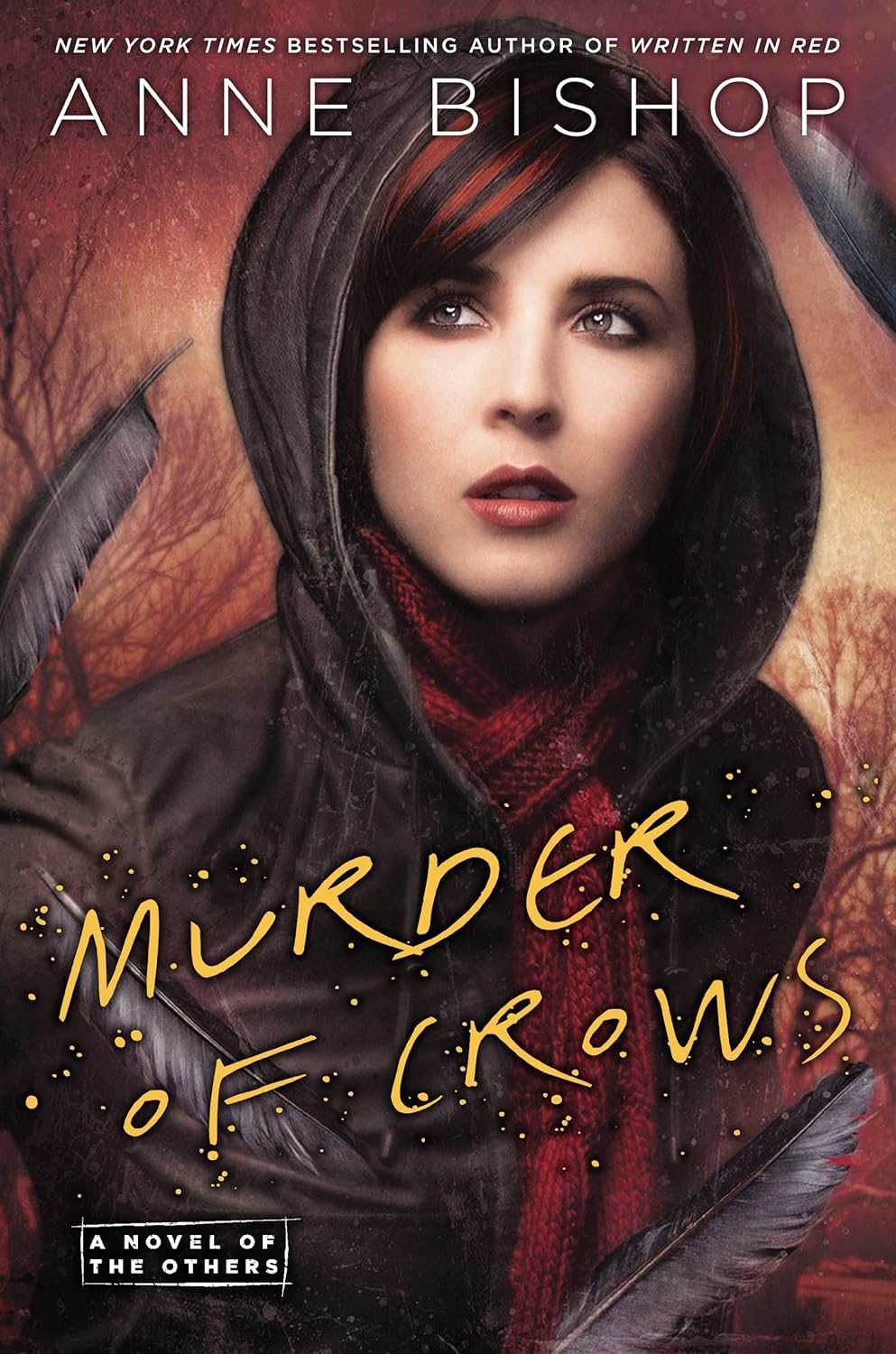
Murder of Crows: Anne Bishop (The Others, Book 2)

Murder of Crows is the sequel to Written in Red--reviewed here. Published in March of this year, this book is only available digitally or in hardcover--for a whopping $26.95, I should mention. I downloaded a digital copy to tide me over until a paperback copy is available.

The start of this novel is not immediate after the end of the previous, although the temporal distance between them is essentially negligible. Things in the human spaces are tense, and "gone over wolf"--the drug unveiled in Written in Red--is making its way around Thaisia.
Humans are baiting the Crows by putting shinies into trash cans on collection day and then poisoning food with GOW: attempted mass murder proceeds. Why Crows? Because they see everything and communicate with their crow counterparts: to put it simply, they know too much.

Although I am thoroughly enjoying Murder of Crows, I do have to admit that it doesn't start out--by which I mean the first 20-some chapters--at quite the same level of intensity. The main drama takes place outside of Lakeside--and in a different region, though growing ever-closer--and the body of what's taking place in Lakeside Courtyard is relationship drama between Meg and Simon. And we all saw that coming. The shoulders over which we're peeking are frequently new to us, the names being dropped are not familiar ones--and while this can feel random to the unseasoned, perhaps unprepared reader, it provides one with a set of puzzle pieces illuminating different areas on a multi-faceted situation--because this thing is bigger than a puzzle, and more complicated than a sphere; it has edges that can't be seen around and thus require a new shoulder to illuminate this plane. I hope you're following.

All the cassandra sangue are prophesying the same thing, regardless of the questions asked, and even the euphoria can't mask the resulting terror/horror. Intuits--a breed of humans with terra indigene-like instincts--are sensing storms that have nothing to do with the weather. "Humans First and Last" is unfortunately gaining traction. Humans in Cel-Romano are building "flying machines." The terra indigene have evicted an entire hamlet for their crimes against the Crows. In essence: Shit's about to go down.

As the novel progresses, it becomes clear that Bishop is placing the reader in a very precarious moral, or ethical, debate: whose side are you on? Are you more sympathetic of the humans and their effort to gain more control over the world in which they're trying to live? Or are you more sympathetic to the Others, whose concern for the world outweighs their interest in the production of goods/services and the use for humans? While reading these novels, I am, of course, provided with the perspectives from both sides, and so I can sympathize with both humans and terra indigene. But am I supposed to sympathize with humans more because I am one, although am obviously living without the existence of a being higher up on my food chain? And if I am, what does it say if/that I'm not on the side of the humans? What does it say about me that I can ethically/morally/psychologically rationalize the motions of the terra indigene and their feelings? I don't know at this point, but it's an interesting question, and it's one that won't really leave me alone. I think that's kind of the point.

This isn't the only issue readers face: in dealing with the cassandra sangue, Namid's wondrous and terrible creation, was it ethical to allow for benevolent ownership? Was it ethical for these girls to be 'owned' and essentially have their lives run as if they were prison inmates? Considering the self-destruction they caused if left to their own devices, was it ethical to let them exist on their own, without guardianship?
While the issue is hardly literally relevant to society, it may be metaphorically ethical when thinking about other things or situations. Currently none come to mind, but I will own the blame for being largely ignorant of current affairs around the globe. With a little thought--and perhaps some extrapolation--I'm sure the ethical question can be overlaid like a projection transparency* upon certain situations.


Murder of Crows was significantly shorter than Written in Red, coming in at 35 chapters and 354 pages--please don't ask me to drop the chapter and page count of the first novel, but it at least felt like at least half again that long, if not twice. Consequently, I had it read in a very, very short amount of time--I bought it yesterday afternoon and finished it about an hour ago**--and I have to admit that I'm kind of disappointed in its length. The ending is good, is concise, but I'm fairly certain leading toward at least one more. It's hard to say with Bishop, but she isn't known for producing short series, so odds are good. Which works in my favor. (=

Until next time,
--Emily

*Did I just date myself by referencing that technology? I'm not even that old! The technology that we had in my school growing up was pretty old because we were a small school with few students (I graduated with a mere*** 21 other kids) and so we didn't get all that much funding. Granted; I started school before 2000, so it's not like other places had SmartBoards and we didn't. But still.

**And I went out bar-hopping with my boyfriend and some friends last night, and spent a long time sleeping to avoid a hangover.

***This is a personal note, and therefore completely irrelevant, but I want to share it anyway. I can't write "mere" without giggling to myself anymore, because my boyfriend and I have shortened "Come here --> C'mere" to simply "mere" whenever we want the other to be less lazy and come provide kisses or snuggles or whatever.

Wednesday, November 6, 2013

The Fifth Sister: (Parched Series 4) Z.L. Arkadie

Sidenote: Apparently the cover images of the books after The Seventh Sister are all minuscule and will probably end up looking really shitty and pixely from here on out. My apologies, but there's really nothing I can do.

The Fifth Sister is the fourth book in Z.L. Arkadie's "Parched" series, with which you should hereby be familiar.
Every single book in this collection is remarkably short and I can read them all in approximately 2 or 3 hours, although that time ends up being split up across the span of a few days, just due to my university schedule/requirements.

This book decides to follow Glo, who is the sister with the power of fire, and for once in Arkadie's series, a sister has a voice which is her own, although yet retaining a semblance of both of the other sisters we've followed thus far.
Glo is apparently 43 without looking a day over 21, with the same exact hair and build as her sisters, whom she has no idea exist. She is attending therapy weekly, because she feels intensely indifferent, frequently anxious and lately depressed. She feels as though she lives in a bubble, and very little exists within it for her. The rest of the world is without, and she considers it almost more of a Lego-land, which... in retrospect, doesn't really tell us nearly as much as Arkadie wants it to.
Glo lives in Cleveland and works in a diner on the ground floor of her apartment building in the warehouse district. This seems unrealistic and bizarrely coincidental for what commences over the course of the novel. Simultaneously, Glo's best friend Aries and her boyfriend are remarkably similar to her, in that they never age, and Aries seems to be able to influence people by touching them. Glo spends the first several pages of this novel feeling anxious, as though she knows instinctually that something is about to change, that her life is meant for something, but she is absolutely clueless about what that might be.

Once again we find rampant grammatical and punctuation errors including word omissions, misspellings, random commas and misplaced quotation marks. The descriptions are mediocre at best and leave one with only a semblance of that which Arkadie is trying to accomplish here. Perhaps it is because of the nature of Glo's current psychology, but considering that this is a theme throughout the course of her novels, I am loath to make that acquiescence. At this point in the game, I am more apt to argue that Arkadie, while creative in her concepts and the layout of her plot, is a mediocre writer in desperate need of a good editor who really ought to take the extra time to proofread her own material.

Glo, like Clarity, has a neighbor in her apartment building for whom she sort of has the hots, and is--surprise, bloody surprise--a vampire. And! SURPRISE BLOODY SURPRISE! Has the exact same powers as Glo. Lord Jesus, could these novels get any more predictable!? Somehow I doubt it.

I don't think that anybody is going to be surprised to hear this: Aries is Glo's [replacement] Guardian (apparently her guardians who were supposed to model 'parents' died in a car/plane crash (it's questionable) years ago) and Raz, Aries boyfriend, is Glo's Wek. Are you surprised? I certainly hope not.

Glo and Finn end up collapsing a lab where Tal and Cort (a couple of names you may remember from the last book as Shams--or vampires who've now acquired the ability to do magic of sorts and drink other vampires)--are forcing chemists to create a drug they call Zombie, but what the drug does goes entirely unexplained until further notice.

Once that's done, they make a trip down to Alabama because Finn knows that's Cort's next target. When they get there, it's a ghost town, much like--surprise surprise--Moonridge was when Quenched closed out.
When that situation is dealt with (in as much capacity as it can be, honestly), Finn and Glo travel up to Ohio and into Jari, where they find Vayle, who is still there--because it's only been like, 5 minutes his time. He has, surprise surprise, decided not to shirk his duties and revert back to human. At his point, Vayle leads the last sister and her bonded vampire out of Jari and to the house of Benel.
The end.

No seriously. That's the end of the book. Frankly, they're more like short stories than novels, and I almost can't even believe I shelled out $4 each for the next two. They hardly seem worth it. I do, however, intend to see this thing to the end, regardless of how it continues to pain or entertain me.

I gave it 2 stars on Goodreads. It didn't really deserve any better than that. Frankly, I'm disenchanted with the series, as if you haven't noticed. (I mean it's not like it's apparent or anything...)

Friday, November 1, 2013

Quenched: Book 3 by Z.L. Arkadie

First and foremost: My sincerest apologies for that dreadful picture quality on the cover. It was legit the biggest file I could find on Google... and I was too lazy to search anywhere else. Sue me.

So Quenched picks up pretty immediately where Parched leaves off, with Clarity resuming as our narrator.

However, the opening several paragraphs of the book are so excessively flowery in terms of the verbiage that it's ridiculous and at moments to the point of intolerable.
A few examples:

"...the blood pumping organ in my chest..." >> Really? Heart wouldn't suffice? I mean, I'd have pardoned it if it was included in some kind of comment about its effectiveness at its function, but all she's getting at is that she's heartbroken from being unceremoniously dumped.

"When their warm breath hits the cold air, the impact generates a misty cloud of frost in front of their faces." >>Although I really do have to acquiesce that I quite enjoy this sentence.

"I remember standing here sometimes on days long past doing just this, admiring how nearby skyscrapers reflect on its" (the UN building) "mirrored skin."
         This is followed immediately by "A lot has changed since then--a lot" as if Arkadie couldn't come up with a better emphasizer than another use of "a lot" because that really tells us anything at all.

Another thing: in the section directly after the above examined, Clarity announces that they are "whizzing past the tops of tall skyscrapers like Superman over Metropolis OR BATMAN SWINGING THROUGH GOTHAM CITY." Excuse me, Ms. Arkadie and Ms. Clarity, but I believe this "swinging superhero" to whom you refer is actually Spiderman and he swings through New York City, not Gotham. I'm just saying.
If you're going to talk about how your life is "as if [you're] living in the pages of a comic book" you should at least get your heroes right. Batman does zero swinging, unless we are on the subject of punches, perhaps, but in this context? Nuh uh.

Moving further through the text just provides more and more instances of these unpardonable errors. Like, maybe I'm being excessively critical on too many fronts, maybe I'm just being picky, but there are some things that are just too ridiculous to let go. The walls of her morphs-into-exactly-what-I-love bedroom are painted lime green, and anybody who knows anything about interior design knows that lime green is too bright/loud of a color for anybody to friggin sleep with. I mean, there are people who will argue with me, but it's a legitimate psychological thing. Furthermore, when she gets on a plane to fly halfway across the globe, she decides to start reading The Iliad and The Odyssey and, because she "reads so fast" she's done with The Iliad in half an hour. SO MUCH BULLSHIT. I don't even care if you're superhuman or whatever. Just no. Absolutely not. 
Skipping over a multitude of glaring grammatical and punctuation errors as well as excessive over-exaggeration, we come to a really ridiculous geographical error. They end up looking for Exgesis (whose name I realize is unfamiliar to you, but I'm sure I'll get to the actual plot at some point or another when I'm done tearing this thing apart limb from limb) in the Black Hills. Which are in west-central South Dakota and extending a bit into Wyoming. And then this boob announces that "Just as [she] thought, he's not in North Dakota." Well how the hell would you know, you idiot? You're in South Dakota.
Granted. I'm a little prejudiced there because I live in the northern Dakota. But seriously?! SERIOUSLY!? DO YOU NOT KNOW HOW TO USE A MAP?! GOOGLE IS FREE! PLEASE USE IT.

Like, don't get me wrong. I'm obviously still reading this thing because the plot is still mostly enjoyable and interesting. Except that there are things being omitted and forgotten about and there are ends she neglects to tie up where they obviously ought to be. And don't you sit there telling me in your head that maybe she's just waiting to divulge it--because she isn't. They aren't things that make any sense whatsoever to withhold, and the characters are having the conversations in which said information really deserves to be divulged. Like, it's part of the damned conversation and it's like they just forget to friggin say it. There's no rhyme nor reason to it; there's no mental explanation of why said information isn't passed on. It just isn't.

Anyway, so in terms of plot, here's the deal: Clarity and Baron have "broken up" because she spent a couple of days in Enu, which amounted to a couple of years on Earth, and because Baron doesn't know that--still doesn't, because she neglects to provide that simple information which would clear a lot of air--he's "moved on." But, because she needs him, she goes back to get his help and they end up going on the aforementioned trip across the globe to find Lario--Fawn's sociopath ex-boyfriend, i.e. Exgesis. While in Europe, they make up and have a fuckton of sex for like, 4 days. Whatever.
So Baron's got a portion of Clarity's light now because they're bonded, which means that he's the "vampire with the power of light" and they're in search of the vampire with the "power of the sun" currently sought by Exgesis.  This is where Zillael and Vayle come in from book 2 (The Seventh Sister), even though I didn't really do a very good job of explaining or reviewing that one in the previous post (sorry). So Zillael is the sister with the power of the sun, and the vampire with whom she's bonded has a portion of her power.

Is it just me, or does this seem slightly cheesy and formulaic the longer we persevere? I dunno. I still enjoy them, but English-majoring my reading material takes some of the fun out of it. So it goes.

The three sisters plus the two vampires and their Weks travel into a place called Nowhere--yes, seriously--and battle off a bunch of soulless beings (which notably resemble Dementors from Harry Potter, and I really wish I was kidding) who disintegrate into ash when Clarity blasts them with light. Honestly, although the sisters are somewhat portrayed to be equal here, Clarity is really elevated to a level above and her Mary Sue tendencies are thicker than the others. Granted, Clarity has her downfalls, but Arkadie struggles to convince you that her downfalls are actually her strengths, and I must admit that I'm not especially buying it.
Clarity returns the leaf from the tree of life--which Fawn had given to Lario to make him human, but we know how well that went--to its place and Nowhere is restored to a healthy, beautiful place. At this point, Felix shows back up and provides the vampires an ultimatum. Over the course of the next 7 hours, while the ground remained churning, they had the chance to either become human and leave it all behind, or to continue on the journey with the girls until it was over, at which point they would be returned the option. Baron, of course, immediately declines to continue taking care of and assisting Clarity, but Vayle is caught in an internal battle because he knows that Zillael loves her Wek more than she loves him and thus his motivation is compromised. The group leaves him crouched there, staring at the ground, and goes home. He is left with three doors remaining open out of the place: one to his old home, one to the home where his mother has moved, and one back to the house of Benel, where he would continue the path he'd been born for.

The novel ends with Zillael and Derek taking a trip back home to Moonridge for candy apples, but upon their return the town is entirely empty and they don't get them. Seriously, the book ends with "I guess there's no rest for the weary, or candy apples either."
Seriously, Arkadie? Seriously? That was the best you could do? I say nay nay.

In the end, frankly, I'm loath to give this one more than three stars on Goodreads. I'm not even entirely certain that it deserves three, though. I'm teetering on the 2 and 3 mark. We'll see where it goes.

Book 4 is called The Fifth Sister, which seems kind of silly to me, but whatever. I bought it, so I'm going to read it. Honestly, as much as it's beginning to pain me, I'm probably going to continue on through the entire series just to see how the thing ends. Call me masochistic, but I prefer martyr. lol.

That's what I have for you. It's a bit longer, so I hope that's more pleasing. Or...something.

Until next time,
--Emily Renae

Tuesday, October 29, 2013

Paper Towns: John Green

Quentin Jacobsen is a mild-mannered guy.  His parents are both psychiatrists.  What the hell do you expect?  And he's a senior in high school.  A bit of a nerd, but not overwhelmingly so.  Actually, all in all, he's relatively boring.  At least at the start of the novel.  He's just a boy.  I mean, don't get me wrong, I imagine him to be a sorta kinda cute-ish boy, but just a boy nonetheless.
And he's practically in love with his neighbor: Margo Roth Speigelman.  (I like the name Margo, just for the record.  At first I thought it was sort of odd, but I grew to rather like it.)  Except that as the novel proceeds, Quentin finds that it's not really Margo he's in love with, it's the idea of Margo.  Because he realizes that he actually really doesn't know Margo--none of them do.
Margo involves him in a night of adventures and then suddenly disappears.  Apparently it's nothing new, as she's run away to do things in the past.  Only this time, she isn't coming back.  Much turmoil takes its place in the pages following Margo's disappearance, and I can't help but sympathize with Quentin.  Simultaneously, knowing what I know, I sympathize with her as well.

As with Looking for Alaska (which I do realize I have not discussed with you), Paper Towns has a lot of philosophy running throughout its pages. Concepts that I think more people need to be introduced/exposed to and made to think about.  Not just because they're big, deep concepts, but because they are important ones that help to allow us to grow as individuals.  At this point in my life, I have actually come to address most of the things discussed in this book already, but John Green has this beautiful knack for addressing it differently than I do.  Obviously, because he's a different person.

For example, one of the themes is that we, as individuals, have a tendency to look at others not as people, but as ideas, as concepts. When we look at a person's behavior and start creating this image of who and what we think this person is, it no longer really matter what this person does, the image of them we have created is who they are in our minds.  And every person will come up with a different image of this person of discussion--that's the trick of it: none of us are going to see exactly the same person because we all have our own internal prejudices and hang ups and baggage that alters how we see everything--even if/when we don't realize it.
Because we are projecting onto others the things we see--or don't see but hold--inside of ourselves, this kind of blocks our ability to actually consider others to be people--individuals--instead of ideas. We become so entranced with the idea of someone that when we actually start to get to know them and begin to discover that they aren't some mystical, entrancing enigma, they're just a person, we become disappointed, in either ourselves, our idea or the reality of the person before us. I don't think any of us can truly escape it forever; I think it's a war in which we win and lose certain battles.

I suppose that ultimately, the purpose of Green's writing is to be both perfectly and beautifully philosophical and yet so endlessly and sadly unfulfilling, since thus is the unalterable nature of life: to ignore what we want and make its own twists and turns and decisions without our prior approval or satisfaction.
In that way, Green's become one of my very favorite authors--for being so philosophical and idealistic while remaining almost brutally realistic.
In discussion with a very close friend of mine over the novel one night, I received this text message: "[...]  I think the main thing with his books is that they masquerade as simple YA literature, but have many of the elements of the classics--namely, that the theme and message take precedence over the plot.  While other endings might be more satisfying from a more simplistic storytelling standpoint, John Green writes the ending that drives his point home and makes his audience think." I include the message because she makes the point more clearly and succinctly than I'd have found myself capable (largely because I'd have been guilty of plagiarism otherwise). Plus it's a brilliant text message and I like to prove that I have wonderful and articulate friends. Whatever.

------------------------------------------

I feel as though my reviews maybe ought to be longer, like maybe I'm not really going far enough.
If you feel this way and would like to hear more from me in the way of actual "criticism", be a dear and comment on any of the posts available. I'd be most happy to oblige. At least in most cases. I try not to drop too many spoilers at the same time, so that certainly limits the amount which I am able to say. We'll see how long this aversion continues and where things go in the future.

Until next time,
--Emily

Friday, October 25, 2013

A Madness of Angels: Or, The Resurrection of Matthew Swift -- Kate Griffin

And so it begins.

Matthew Swift is a sorcerer in London, but it is immediately apparent that he is more than that. He has been resurrected after having been dead for approximately two years.

Before the night is out, Matthew is attacked by a "litterbug" (a summoned monster composed of, you guessed it, garbage. Which, for the record, he defeats with a dustbin. Not to ruin it. It's a marvelous scene.

Newly resurrected, Swift's sole missions are to (a) find his murderer and return the favor, and (b) find who resurrected him, find out why, and then, quite likely, kill them as well.

So the novel progresses and you learn more and more peculiar things about this Swift, but things are still left unsaid, left in the dark and unexplained, leaving an air of mystery and suspense until finally the truth is spilled--but not all of it. Only one set of truths. As the book progresses, truths are revealed in clusters until finally the book ends and the final shoe finally drops. The perpetual mystery and vague confusion coupled with the peculiarity of the narrative--due to the intrinsic peculiarity of the narrator--are large parts of what keep the novel moving at the Andantino cum Accelerando (a little faster than "a walking pace" but steadily speeding up) tempo that it does.

The prose is marvelous and intriguing; Griffin doesn't write in chapters. Sections are broken up with white space or " * * * "; larger sections are broken up as "Part One: [Title]", "The First Interlude: [Title]". It's fascinating. And I totally love it. But there's also a number of places where the writing totally breaks into stream of consciousness style, which is also terribly moving in-context. (Also because I know things you don't. hahaha.) It can catch you off-guard if you allow it to, but if you just get lost in the text as you're reading, it just works right into the story. Some of the paragraphs are these great, barely-connected run-on sentences (one or two sentences total in the paragraph) and it's magnetic. It really keeps you moving through the material because it's different in that it's a frequent change in prose style, which catches your attention even when you aren't conscious of it.

Sidenote: I'm terribly amused at the little sticker on this cover which proudly proclaims "Only $19.99!" as if that's somehow cheap for a novel. I think I paid $7.99 for mine? Maayyyybe $8.99. It's just kinda funny. That's all.

Solid 5 stars on Goodreads. Always. Every time. (Even though I'd have to buy it again if I ever wanted to read it again because I lent it to my ex-boyfriend and he's now had it--and the second--for almost two years and refuses to answer my texts/calls when I'm in town. Asshole.)

So there it is!

Until next time,
--Emily

Thursday, October 24, 2013

A Brush of Darkness, A Sliver of Shadow, A Trace of Moonlight: Abby Sinclair Books 1-3 -- Allison Pang


So here's the deal.
Abby is the TouchStone for the Fae Protectorate, who is actually a princess, though I don't recall if that's stated right off the bat. So that could probably be a spoiler. Oh well.

This incubus named Brystion (nicknamed Ion) shows up and asks her to help him find his sister (a succubus, in case that didn't occur to you) but "off the radar" in a manner of speaking.  There's some real shady business goin on and because the three paths (Heaven, Hell, Fae (who are apparently a middle ground or something if I recall correctly?)) are not exactly on the BEST of terms, things should be kept on the down-low.

Things get complicated, as they always do; Abby turns out to be a Dreamer, which is something that he explains the meaning of but we still don't really get to see it (even by the end of book 2) because Abby hasn't learned how to control it yet. She's haunted by some pretty severe nightmares, though; nightmares she can't let go.

The bad guy here is Maurice. It's been too long since reading it for me to tell you most accurately what the deal is exactly. But he basically, like, painted Brystion's sister (and then Abby and I think a couple other people?) into these ugly ass paintings. And Abby ends up stuck in this painting with sharks (her biggest fear (which is totally irrational since she's never even seen one)) and she almost dies and there's a whole bunch of really tense drama and stuff. And then blah blah blah she's saved and whatever.

Brystion and Abby have this super heated love affair--go figure--but it's... it's... I liked it. I mean, it was nice. beautiful, in a way. passionate. But he left her anyway. That pissed me off. But she gave him a place in her Heart of Dreaming or whatever, so... I mean... there's that. (He can't have one because he's an incubus.)

It received a full 5 star rating on Goodreads by yours truly because I felt that the prose combined with the storytelling and the plot itself all deserved it. The dialogue doesn't even feel forced, you guys. So many people have so many problems with dialogue that it's really nice when someone gets it so very, very right.


As an aside, this model has a different facial structure (and body frame) than the last one. I'm not sure how I feel about it... Also, all of her hair is pink and purple in this one instead of just her bangs... Meh.

So here we go again. Sorta.

Maurice is in jail but the Queen is going insane and the Fae court is kind of a wreck. Moira's baby is in Abby's care until she hands him off to his father (which is a scandal!) to take care of stuff.
Now there's romantic stuff brewing with her body guard Talivar, who turns out to be the prince and Moira's half-brother.

Clusterfuck after clusterfuck. The Queen shuts down the CrossRoads, which puts the entire metaphysical community afluster, strands some, kills others, etc. The Demons actually threaten war on the Fae, which is actually where this one kinda leaves off. Because Talivar and Abby accidentally start it and then Abby pulls a stupid in order to save him and Brystion--who have a weird love triangle thing going with Abby now, which is... strange... but amusing and interesting nonetheless.

I was VERY unhappy about where this book ended. Very unhappy indeed. If you're unhappy because I just said a whole ton of nothing, I apparently grew weary of typing this post. And there's too much that counts as serious plot spoilers. And I don't wanna ruin TOO much. I already dropped a couple huge things there, even if you don't realize it yet.

This book also got 5 stars because, let's face it, I'm basically in love with them. They're so worth it. Entertaining and provocative and definitely different.


So um... here's the thing:

I read this so long ago now (and have read so much material since then) that I don't especially remember much of it.

I know that a number of things get resolved but least that many things really don't.

Gimme a break; I'm just copying these reviews over from my old blog. =/

Look: It's just as good as the other two and worthy of yet another 5 star rating on Goodreads. I fell in love with Pang's material and I heartily recommend it to any fans of paranormal romance literature. Because the sex in here is hot. The sexual tension is also really excellent, for the record, which there is much more of than actual sex. Just saying.


So that's that.


Until next time,
--Emily