Showing posts with label novel. Show all posts

Sunday, June 1, 2014

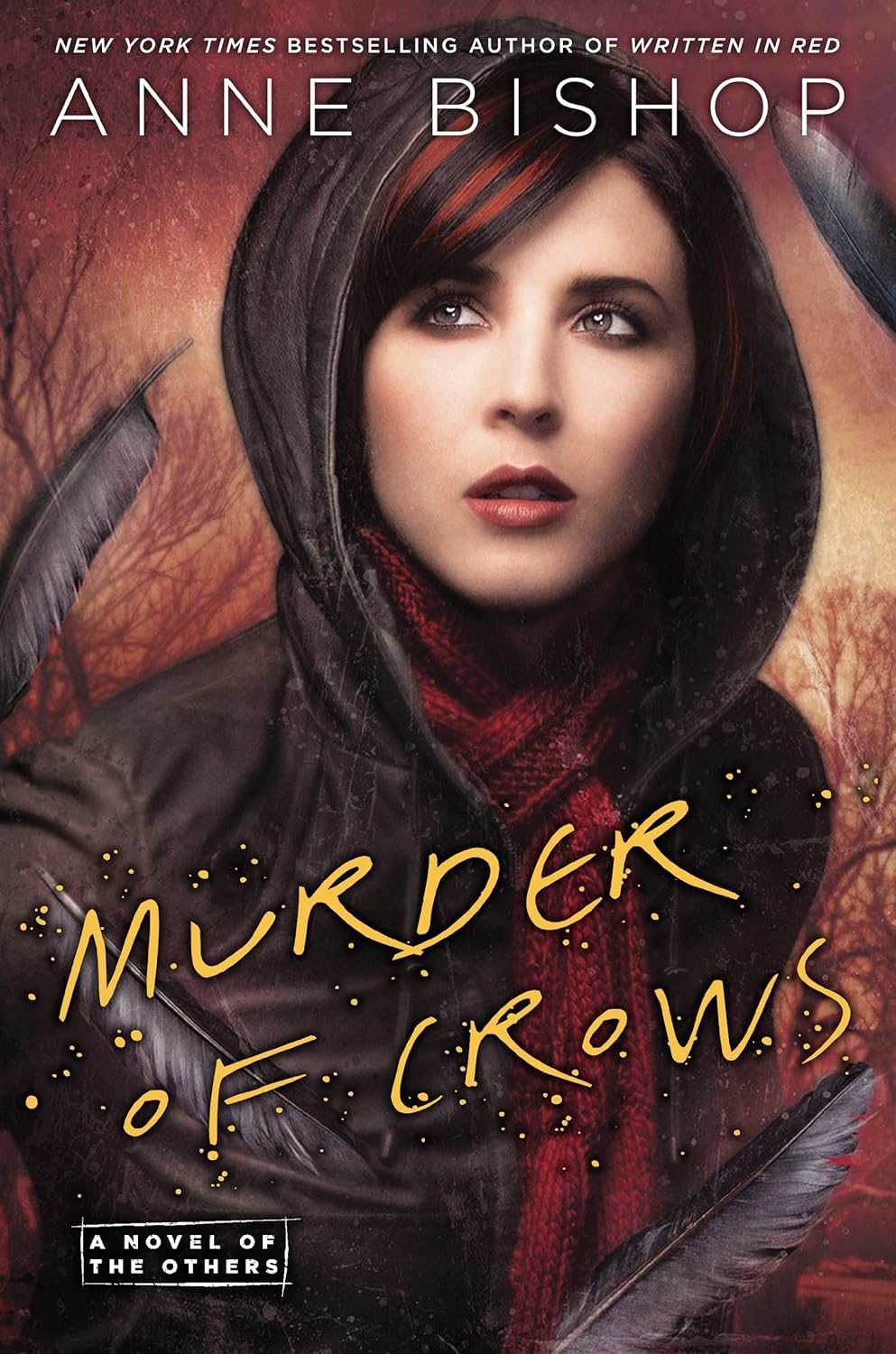
Murder of Crows: Anne Bishop (The Others, Book 2)

Murder of Crows is the sequel to Written in Red--reviewed here. Published in March of this year, this book is only available digitally or in hardcover--for a whopping $26.95, I should mention. I downloaded a digital copy to tide me over until a paperback copy is available.

The start of this novel is not immediate after the end of the previous, although the temporal distance between them is essentially negligible. Things in the human spaces are tense, and "gone over wolf"--the drug unveiled in Written in Red--is making its way around Thaisia.
Humans are baiting the Crows by putting shinies into trash cans on collection day and then poisoning food with GOW: attempted mass murder proceeds. Why Crows? Because they see everything and communicate with their crow counterparts: to put it simply, they know too much.

Although I am thoroughly enjoying Murder of Crows, I do have to admit that it doesn't start out--by which I mean the first 20-some chapters--at quite the same level of intensity. The main drama takes place outside of Lakeside--and in a different region, though growing ever-closer--and the body of what's taking place in Lakeside Courtyard is relationship drama between Meg and Simon. And we all saw that coming. The shoulders over which we're peeking are frequently new to us, the names being dropped are not familiar ones--and while this can feel random to the unseasoned, perhaps unprepared reader, it provides one with a set of puzzle pieces illuminating different areas on a multi-faceted situation--because this thing is bigger than a puzzle, and more complicated than a sphere; it has edges that can't be seen around and thus require a new shoulder to illuminate this plane. I hope you're following.

All the cassandra sangue are prophesying the same thing, regardless of the questions asked, and even the euphoria can't mask the resulting terror/horror. Intuits--a breed of humans with terra indigene-like instincts--are sensing storms that have nothing to do with the weather. "Humans First and Last" is unfortunately gaining traction. Humans in Cel-Romano are building "flying machines." The terra indigene have evicted an entire hamlet for their crimes against the Crows. In essence: Shit's about to go down.

As the novel progresses, it becomes clear that Bishop is placing the reader in a very precarious moral, or ethical, debate: whose side are you on? Are you more sympathetic of the humans and their effort to gain more control over the world in which they're trying to live? Or are you more sympathetic to the Others, whose concern for the world outweighs their interest in the production of goods/services and the use for humans? While reading these novels, I am, of course, provided with the perspectives from both sides, and so I can sympathize with both humans and terra indigene. But am I supposed to sympathize with humans more because I am one, although am obviously living without the existence of a being higher up on my food chain? And if I am, what does it say if/that I'm not on the side of the humans? What does it say about me that I can ethically/morally/psychologically rationalize the motions of the terra indigene and their feelings? I don't know at this point, but it's an interesting question, and it's one that won't really leave me alone. I think that's kind of the point.

This isn't the only issue readers face: in dealing with the cassandra sangue, Namid's wondrous and terrible creation, was it ethical to allow for benevolent ownership? Was it ethical for these girls to be 'owned' and essentially have their lives run as if they were prison inmates? Considering the self-destruction they caused if left to their own devices, was it ethical to let them exist on their own, without guardianship?
While the issue is hardly literally relevant to society, it may be metaphorically ethical when thinking about other things or situations. Currently none come to mind, but I will own the blame for being largely ignorant of current affairs around the globe. With a little thought--and perhaps some extrapolation--I'm sure the ethical question can be overlaid like a projection transparency* upon certain situations.


Murder of Crows was significantly shorter than Written in Red, coming in at 35 chapters and 354 pages--please don't ask me to drop the chapter and page count of the first novel, but it at least felt like at least half again that long, if not twice. Consequently, I had it read in a very, very short amount of time--I bought it yesterday afternoon and finished it about an hour ago**--and I have to admit that I'm kind of disappointed in its length. The ending is good, is concise, but I'm fairly certain leading toward at least one more. It's hard to say with Bishop, but she isn't known for producing short series, so odds are good. Which works in my favor. (=

Until next time,
--Emily

*Did I just date myself by referencing that technology? I'm not even that old! The technology that we had in my school growing up was pretty old because we were a small school with few students (I graduated with a mere*** 21 other kids) and so we didn't get all that much funding. Granted; I started school before 2000, so it's not like other places had SmartBoards and we didn't. But still.

**And I went out bar-hopping with my boyfriend and some friends last night, and spent a long time sleeping to avoid a hangover.

***This is a personal note, and therefore completely irrelevant, but I want to share it anyway. I can't write "mere" without giggling to myself anymore, because my boyfriend and I have shortened "Come here --> C'mere" to simply "mere" whenever we want the other to be less lazy and come provide kisses or snuggles or whatever.

Friday, April 25, 2014

Written in Red: Anne Bishop (The Others: Book One)

I am getting very, very tired of being unable to find book covers on Google bigger than 300 friggin pixels. I had to take this one and upload it from my phone. So I'm sorry if it looks like a cell phone picture (even if I do have a GS4...)

Written in Red is the first book in what looks to be perhaps the most interesting fantasy series I have ever read--even more interesting than Bishop's older Black Jewels series, a set of novels I devoured several years ago as a middle schooler. First published last year, but released in paperback in March of this year, the obvious question that follows that claim is: What makes this book different?

As seen in three series prior to this from Bishop, the author is far from averse to creating her own universes. Black Jewels, Ephemera and Tir Alainn are all series set in unique landscapes, designed to facilitate the types of events that play out within them. Unlike the three series listed above, The Others is a series that takes place in a world quite similar to our own, but with some very key differences.

Namely, humans are definitely not at the top of the food chain. Taking their place in Namid, the name for the world in which they live, are the terra indigene, or, the 'Earth Natives'. Preceding the story is a brief history of the world, which explains that when humans tried to spread out onto new continents, the Others ate them. All of them. The third human to lead his people into the Others's territory was smarter than his predecessors and brought trade items, which paved the way for human-terra indigene interaction over the course of the next several generations until hamlets became towns became cities, but were still under the thumb of creatures far from averse to eating them.

The novel follows a young woman (age 24) by the name of Meg Corbyn, who has escaped from somewhere and is seeking someplace to live freely. She finds herself in a Courtyard (areas fully controlled by Others in which human law does not apply) and applies for a position called "Liaison"--even not knowing what it meant. Simon Wolfgard (a Wolf, but for the first time in my fantasy career, never a werewolf) hires her instead of turning her away, even though her hair stinks (she dyed parts of it orange in an attempt to disguise herself) and it is apparent that she's not quite telling him the whole truth. It turns out that the Liaison's job is actually a mail collector/sorter/distributor, and must be human because of a slew of impertinent-here reasons.
As Meg acquaints herself with the position, she sets numerous terra indigene on edge, irritates many, confuses many others, and befriends every single one of them. Meg's life before running away was a caged one, in which she was considered property and designated CS759--cassandra sangue 759: Meg was a blood prophet, whose skin was deliberately sliced open in order to obtain prophecies from her... for a price. A steep price, as it were, which is why her Controller is rather insistent upon her return.

The main plots in this novel--and there are definitely more than one--include the plot for reaquisition of Meg Corbyn, an aspiring actress's attempt to gain forbidden information and ultimately steal a Wolf pup, and the sudden appearance of a terrifying new drug that cannot be explained by humans or terra indigene until the very end, when Simon Wolfsgard figures it out--although that's a secret you can't make me divulge.

Through a dramatic series of frustrating events, told through a cycle of perspectives not limited to Meg and Simon, we get to know a relatively large cast of characters through not only their own consciousnesses, but also through the minds of those around them. While the novel is packed with drama and high tension, there is also a massive amount of humor--two things Bishop is very, very good at pairing and balancing. Because Meg manages to befriend nearly everybody--including those the Sanguinati (based on Vampires, but definitely more dangerous than that) and Wolves privately fear--her health and well-being are highly important to a number of persons, and when those two things are threatened, the human populations (especially her enemies) are essentially attacked via weather until the threat is, how shall I say, neutralized.

Having thoroughly enjoyed Ms. Bishop's Black Jewels series, I admit that I had very, very high expectations for this novel. However, where Black Jewels was often crass and indelicate--particularly in terms of sex/uality--The Others has none of that, although as of yet the sex has been glossed over when it's appeared, although I suspect that the glossing is more because it's irrelevant than because she's not intending to highlight it ever. It wouldn't be the author's style. Written in Red so exceeded my expectations that I have shirked my duties the past two days just to read it. Now that I've finished it, I'm slightly perturbed that I didn't buy the second book at the same time. In my defense, I was broke, and buying it was kind of an act of defiance. (Leave it to me to be rebellious by buying a book.)

Bishop's novel has received five brilliantly shiny gold stars from this lit critic and novel enthusiast. As an enthusiast, my opinion may be a bit biased--especially considering how fond I am of the author--but nobody's complained about my interpretation yet, so I guess I can't be that opaquely slanted. Or maybe I am, and that's not a bad thing yet.

With that, I have nothing more to add.

Happy reading
--Emily Renae

Monday, February 24, 2014

Rot & Ruin: Jonathan Maberry (Rot & Ruin - Book 1)

Rot & Ruin is the first book in a series of 3 (maybe 4?) books set post-zombie apocalypse.

The novel(s) follow(s) Benny Imura, younger brother of 'zombie slayer' Tom Imura, who is in desperate need of an occupation to which he can actually commit.

He ends up apprenticing with his older brother, but he has a lot to learn over the course of the novel. Fortunately for us, he does seem to figure out how to grow the fuck up. I mean, he's only 14 (I believe) so it's not like it's that unreasonable that he'd be immature, but nonetheless.

Quite frankly, although there are a lot of things that I could say about this book, there's really only one that I particularly want to--the reason that I'm reviewing the novel at all:

I thoroughly appreciate the way that Maberry has worked his zombies and such. It is a disease, but they don't know what it is or what caused it, but literally anybody who dies at this point will reawaken a zombie unless 'silenced', which is a practice of taking a metal pin thing and shoving it into the spinal column in the back of the neck to sever the nerves, etc. Also, they kind of just stand in place without anything to stimulate their senses. They have to hear noise or see movement in order to "animate." Going out into the wilderness is still dangerous, of course, but that at least makes it a little easier.

However. My main criticism of this novel is simply that it's aimed at such a young audience. This book is aimed at males ages 10-15 approx. Obviously I'm a 21 year old female and therefore not the intended audience, but that isn't the point. Maberry's prose is so hollow; there's so much that he could be doing with this series, so many things that could be really delved into deeply, but aren't because of the intended audience. Don't get me wrong, it's done very well as is, but I just really feel like it could be so much better if it was aimed at an older audience.

So. By all means go read it, but buyer beware: Unless you tend to rather enjoy tween lit, you'll feel a little disenchanted.


Unrelated: I got my boyfriend to read this and the sequel, Dust & Decay, because he'd been complaining about not really reading anymore and I wanted to fix that. He read each of them in about a day and a half I think, and he is intending to order the 3rd through Amazon so that he can finish (theoretically) the series. He, like me, hates to leave things unfinished. Plus, the second one ends on one helluva cliffhanger.


Until next time,
--Emily

Sunday, February 23, 2014

Soulless: Gail Carriger (The Parasol Protectorate - Book 1)

CONTAINS SPOILERS. BE ON YOUR GUARD.

Soulless is the first novel in a series of 5 by Gail Carriger, a writer who is both hilarious and brilliant, and unquestionably has my loyalty after just this one novel.

I read it in the span of about a day and a half, just purely because I was so into it. And I was putting off my homework. As per usual. So sue me. (Don't, please, I beg you.)

Although the common mythology is that vampires and werewolves lack souls because they're "undead" if you will, Carriger has flipped this concept around, instead claiming that they have an excess of soul, which is what allows them to be supernatural in the first place. Alexia Tarabotti, our heroine, is what they refer to as a preternatural, or an otherwise normal human being who has been born without a soul. What this means is that she counteracts all supernatural-ness; coming into contact with a supe causes an immediate reversion to humanity for the werewolf/vampire/ghost in question, which is particularly interesting and, at times, sort of dangerous. This soullessness is, in fact, hereditary, and she got the trait from her Italian father, a heritage she and her family are most embarrassed about because they are, after all, British in the nineteenth century. (From my studies, I've gathered that this disdain of foreigners was a pretty solid thing for these people; whether or not it still holds is up in the air.)

Because supernaturals are "public," if you will, there had to be some manipulation of history in order to account for it all. It's actually quite genius, the way that things are perfectly accounted for and addressed. I wasn't even expecting such interesting developments. Also, there is an overseeing organization called BUR--an acronym I've unfortunately forgotten at the moment, and my novel is across the room, and I'm naked and in bed, so I'm not getting it to tell you. Suck it--headed by one Lord Maccon, the 20-years new Alpha of the Woolsey pack.

Alexia is particularly bold and educated in the sciences, etc. Her father is dead and has been for quite awhile, and her mother remarried a proper Brit and had two more daughters--and I'll be the first to tell you that Alexia's entire immediate family is a group of bloody twits.

Anyway. The plot of this novel is that roves (independent vampires not connected to a Hive--as opposed to a coven) are going missing, and new, uneducated vampires are randomly showing up. Not only that, but Alexia's being targeted and followed and such. Drama and hilarity ensue, and untoward romance sparks between Alexia--considered a spinster at age 26--and Lord Maccon, which is also bloody hilarious, I should mention.

The remainder of the plot and such is certainly worth discussion, but I'm not going to thrill you with it because it simply won't do to elaborate on the entire plot, now, will it? What would be the point in ruining it? Regardless, it's definitely worth a read.

I've begun reading the second book--because, true to my nature, I bought all 5 of them at the same time. Dangerous practice to get into, but usually worth it. At least for me. (= --aaaaand it's just as brilliant as the first. And I'm not even a full chapter into it yet. lol. So worth it.

I'll get back to you when I have more to offer. (=


Until next time,
--Emily

Saturday, December 21, 2013

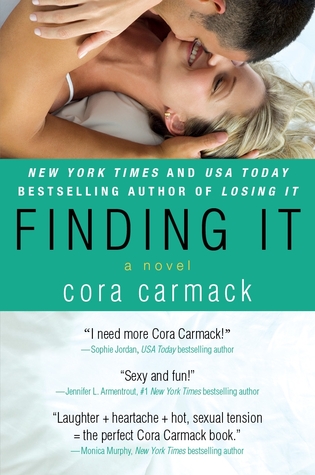
Finding It by Cora Carmack

MAJOR SPOILER ALERT. DO NOT READ IF YOU ARE GOING TO GET SERIOUSLY MAD AT ME BECAUSE YOU HAVE THUS BEEN WARNED.

Finding It is the third book in Cora Carmack's "Losing It" series. Each of the three books, Losing It, Faking It, and Finding It follow a different protagonist, but all of them tie together via a character named Bliss, and this is, so far, the only connection I've found between them. (I haven't read the first one, but I do believe that it's Bliss's story.)

Finding It follows Kelsey, who is backpacking around Europe to acquire a story, or a collection of them, which would make the rest of her boring, uncomfortable life--to which she has resigned herself--worthwhile for the sake of having said story(ies). The problem is that, regardless of where she goes, she does the exact same things: Gets appallingly drunk and has meaningless sex with men she deems attractive enough to get her lady parts excited.

And then along comes Hunt, and he rocks her world so hard that she can't get it back on straight, as if it were to begin with. Suddenly, the two of them are off on an adventure so real--and so sexually frustrating--that Kelsey is finally forced to face the demons of her past. The problem is that she doesn't want to because, gee imagine: it's painful. She's spent her entire life running from her pain and telling herself she was being overly dramatic and it didn't matter--because they were the lies her parents fed her when she was vulnerable--and now that she's faced with something real, something that matters, she is haunted by all of that which she has allowed to happen which didn't [matter]. And it's causing her panic attacks, some milder than others. But she keeps trying to be an alcoholic.

What you learn is that Hunt has his own ghosts, his own muddled past which he's trying to keep hidden as well. But when these two get together, there's nothing which can keep them apart, not even Hunt's willpower. He wants Kelsey so badly he can't handle it, but he waits, and waits, and waits, because he wants it to actually mean something.

The climax of the novel is the heart-wrenching discovery that Hunt was hired by Kelsey's father to keep an eye on her in Europe and has been following her for the past couple of months. But when he saw her falling into his old patterns, he couldn't help but step in and try to save her from a downfall infinitely worse than that which she was already burying.

Kelsey runs away, heartbroken and angry, and instead of going home, she sets up a new life in Spain and becomes a teacher (in English, of course) with a second job in order to pay her bills and survive efficiently. But soon, Hunt is leaving her letters, and when she ignores them, they start appearing everywhere until she finally gives in and reads them. All of them.

The novel is a very fast read; I started it before bed one night and finished it the following afternoon in approximately 5 hours or so total. Maybe. If that. It's a light read, although much of the material is heavily laden with enough emotion to have sent me into a book hangover for several hours. Finding It is well-written and beautifully executed; the tension is real, as is the dialogue, and the places are described well enough that you feel as though you're there. The characters in this book are disastrously paralleled to my own relationship, and perhaps that's why it affected me so thoroughly, but I found it highly pragmatic and very moving.

I gave it 5 stars on Goodreads because I enjoyed the shit out of it. I thoroughly enjoyed Faking It as well; I just read it long enough ago that I'm not convinced I could give a sufficient review on it. (Apologies.)


--Emily Renae